
Training Made (Too) Easy

“Football is a simple game complicated by people who should know better.”
- Bill Shankly
As coaches we help players to develop skills for to an invasion game. The fundamental principles are, in essence, get the ball from zone A (wherever that may be) to zone B to then put the ball into the target (goal). How exactly that occurs isn’t massively important, except for the purpose of preference. Or the development of young players.
In game the overall picture will be that of equal numbered teams facing off. However, when zooming into the region of the pitch occupied by the ball we may see a small numbered match-ups; 3v3 perhaps or overload/underload (4v2 perhaps). There will be different match-ups away from the ball, often a defensive overload or a spare player in the furthest position away from the ball.
A portion of training, which will be larger or smaller depending on the beliefs of the coach, will aim to replicate the game. This can be through equally matched or underloaded/overloaded scenarios. The coach may also suggest a method, such short passing or dribbling, to achieve an aim. That aim largely boiling down getting the ball from zone A to zone B or preventing the ball from moving from zone A into zone B.
Which all means that training can be super simple and super effective without requiring complicated set ups. All that is required is the game with a little careful engineering.
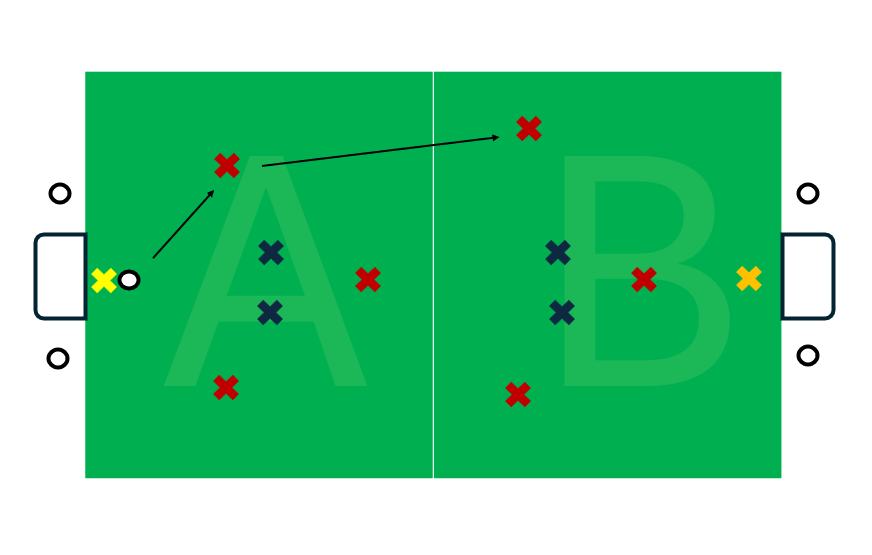
In this example the pitch is divided into two (zone A and zone B). The reds have a 3v2 plus their goalkeeper in zone A and a 3v2 plus the blue goalkeeper in zone B. Reds aim to get the ball from zone A into zone B to try to score. All players are locked in their zones, except for if blue gain possession, then all blues can attack. In this version reds are encouraged to pass the ball from zone A to zone B, with the aim to develop forward passing.
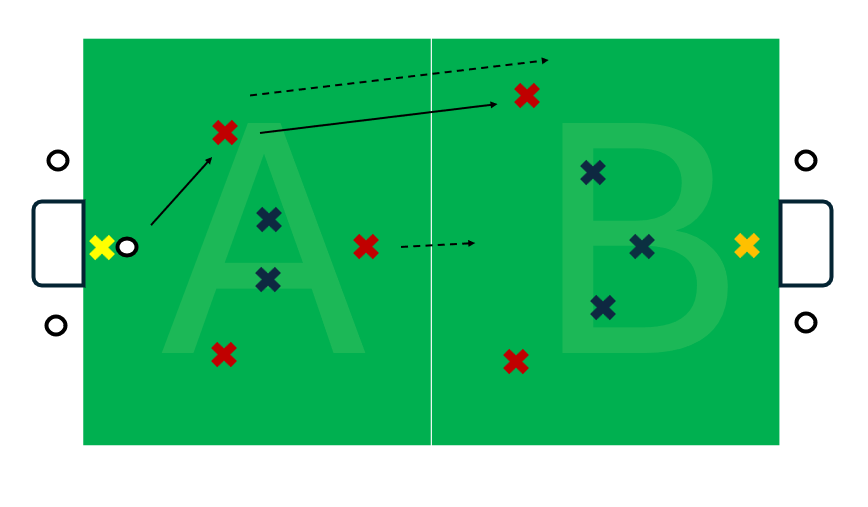
In this example the reds have an overload in zone A but an underload in zone B. If red play forward from zone A into zone B, reds can join to create an overload. The aim is to develop supporting movement in attack and attacking combinations.
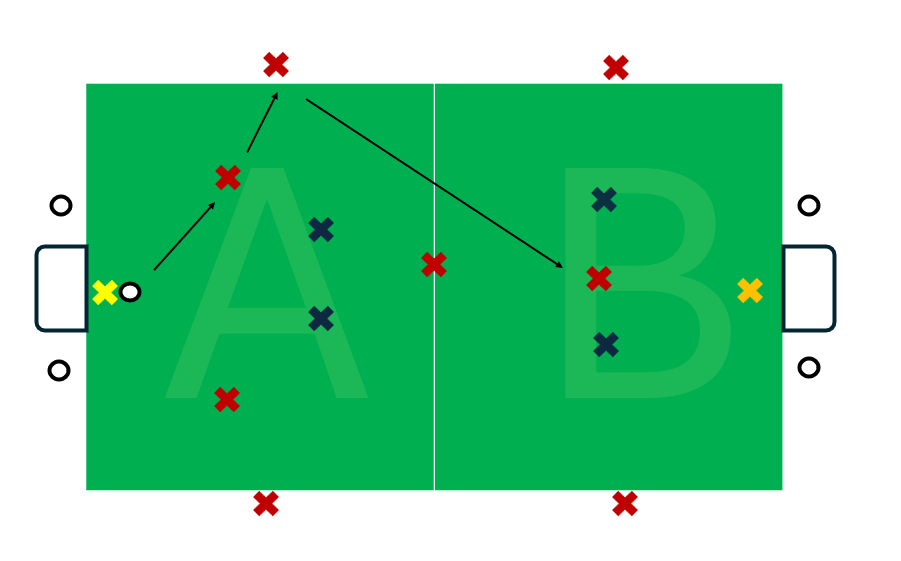
In this example red and blue are matched up 2v2 in zone A and 2v2 in Zone B but one of the reds begins on half way. There are two reds positioned wide on the sides of the pitch. Red can use the the outside players in zone A to play forward into the red on half way or in zone B. From zone A the reds can also play directly into either the red on half way or in zone B. Once the ball is in zone B the reds can play to either of the outside players. To encourage more attacking movements and combinations the outside players in zone B can cut inside, with the outside players from zone A overlapping.
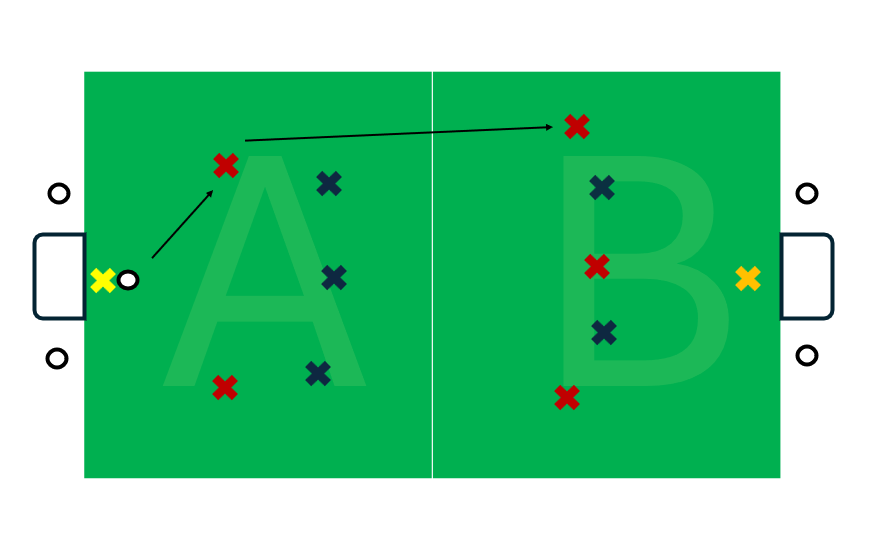
In this example red are 2v3 plus their goalkeeper in zone A. In zone B red have the overload, three reds vs two blues plus their goalkeeper. Reds will need to get the ball forward quickly to capitalise on their overload.
There are endless possibilities with players being able to move from zone to zone in order to create overloads. Players could be positioned on the sides, at the ends, on the half way line as connectors or blockers plus the option to include magic players. The magic players could provide the variable of being able to move between the zones.
The set up is easy. It is recognisible as the game of football, with a few conditions designed to ask questions of players, posing them football related questions that they will have to solve with their decision making.
It is so very important for players to have the ability to make football related decisions that transfer into the game. Those decisions will connect to core skills and the principles of play. A simple set up then enables the coach to focus on coaxing abilities from the players, rather than having to teach players the rules of a game, expending their energy on making sure a practice is running correctly. That valuable energy can be poured into helping the players.